Honestly, if your kitchen feels a little bland, choosing two tones is a smart move for adding character to the space. This lets you move past single-color schemes and really get creative with pairings, perhaps a timeless navy and white, or something more unexpected like emerald and gold.
Deep Teal Cabinets Ground a Bright White Kitchen

When your upper white cabinetry feels too light, consider adding a rich, deep teal to your lower cabinets and island base. This two-toned arrangement sits directly below the white.
Soft Grey and White Two-Toned Kitchen Cabinets

Soft grey lower cabinets pair with crisp white uppers. This two-toned approach adds subtle depth to your kitchen without overwhelming the space.
The lighter upper cabinets maintain openness, while the grey base grounds the overall cabinetry.
Deep Blue Cabinets Create a Bold Contrast with White Countertops

If you’re looking to ground a kitchen, deep blue lower cabinets offer a clear line against crisp white countertops. Natural wood bar stools alongside them bring in a warm, textured material.
Deep Navy Cabinets Anchor White Kitchen Elements

Deep navy covers the lower cabinets, sitting against white countertops and upper cabinetry. This dark color contrasts with the bright white elements.
Dark Gray Cabinets Anchor a White Kitchen with Subway Tile

In the kitchen, dark gray lower cabinets sit below white uppers. A classic subway tile backsplash runs behind the white cabinets.
Mint Green Upper Cabinets With Subtle Texture

Upper cabinets in a soft mint green feature a subtle embossed pattern, folding understated detail into the room and pairing neatly with the deep teal base units below. The textured finish prevents flatness.
Dark Grey Cabinets Pair with Natural Wood Countertops

In the kitchen, deep charcoal lower cabinets are topped with a warm wood countertop. Simple wooden knobs are on the cabinets.
Dark Island Cabinets Complement Warm Wood Floors

Dark grey lower cabinets, topped with a warm wood countertop, sit beneath white upper cabinets and echo the rich tones of the hardwood flooring.
Deep Blue-Grey Cabinets Contrast with Creamy White Upper Units

Deep blue-grey lower cabinets meet creamy white upper cabinets, creating a two-toned effect that keeps the kitchen’s upper portion open while the lower base holds a darker color.
Two-Toned Kitchen Island with Beadboard Base

For a break in the cabinetry, use a kitchen island with a butcher block countertop. Its beadboard-paneled base is a soft blue-grey.
Dark Grey Cabinets with Brass Hardware

When you need to ground a kitchen space, dark grey lower cabinets are a strong starting point. Sleek brass hardware provides a subtle gleam against the dark finish.
Glass-Fronted Upper Cabinets Show Barware and Bottles

White upper cabinets with glass fronts openly display neatly organized spirits and glassware, adding a personal detail to your kitchen or bar area.
Dark Blue Base Cabinets with White Shaker Upper Cabinets

Below, dark blue base cabinets set a strong color line. White shaker upper cabinets sit above, their clean lines complementing the deep blue.
Sage Green Base Cabinets Pair with Crisp White Upper Units
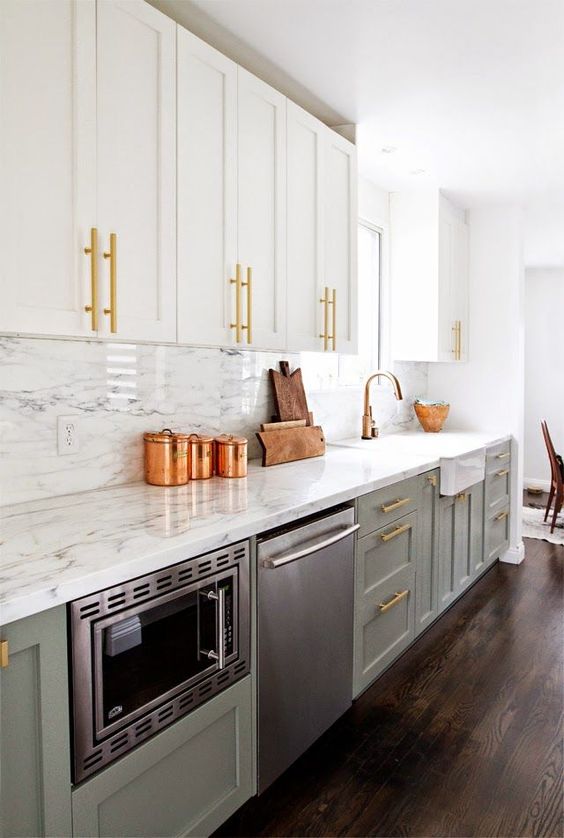
Sage green base cabinets ground the space, while crisp white upper units keep things airy overhead, with brass hardware linking both colors for a subtle warmth.
Warm Wood Cabinets Pair with Sleek White Upper Units

Around the room, wood base cabinets sit below smooth, high-gloss white upper cabinets. The rich grain of the wood provides a distinct surface against the reflective white.
Wood-Paneled Niche Adds Warmth to White Cabinetry

Vertical wood paneling fills a kitchen niche. This recessed area makes a strong statement next to bright white upper cabinets.
Dark Upper Cabinets Contrast with White Subway Tile Backsplash

Dark upper cabinets sit against a white subway tile backsplash. The white tiles offer a clean, bright backdrop.
Light Blue Upper Cabinets Contrast with Dark Wood Base Cabinets

Pale blue upper cabinets sit above a dark wood base. This lighter color provides a clear difference from the lower section.
On the left, integrated shelving offers a spot for books or small decorative items.
Warm Wood Island Base Grounds Sleek White Upper Cabinets

In the center of the kitchen, a wood-paneled island brings a contrasting material. Its rich grain sits beneath sleek, high-gloss white upper cabinets.
Dark Wood Grain Cabinets Reflect Light with Mirrored Backsplash
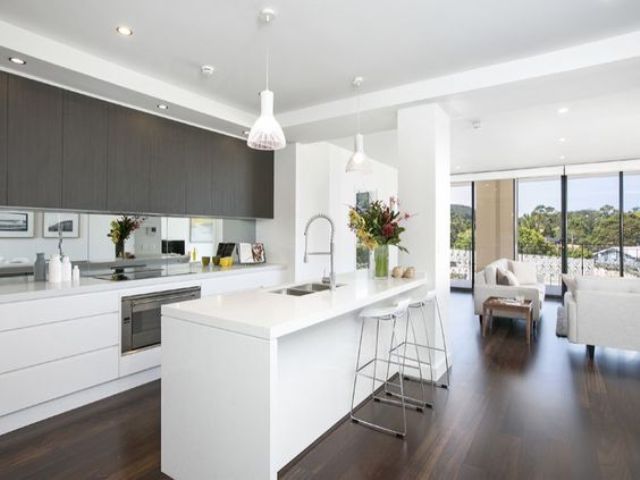
Dark wood grain upper cabinets, with horizontal lines, combine with a mirrored backsplash to send light around the room, sitting above white base cabinets and countertops.
Bright Yellow Trim Adds a Pop of Color to White Cabinets

If your white kitchen cabinets and island feel too plain, a thin band of bright yellow trim can outline them. This detail sits against the white surfaces and warm wood overhead cabinets.
Cork-Fronted Cabinets Add Natural Texture Above Dark Base Units

If you’re looking for an unexpected material, choose upper cabinets with cork fronts. These sliding-door units sit above sleek, dark base cabinets.
Sage Green Base Cabinets Ground a Bright Kitchen

Pale sage green base units pair with bright white wall cabinets. This two-toned effect works best in kitchens where you want to keep the upper space visually light.
The deep green helps anchor the lower half.
Gray Base Cabinets Pair with White Upper Cabinets and Open Shelving

When you’re planning a two-toned kitchen, consider dark gray base cabinets with white upper cabinets. Above the white uppers, open shelving holds woven baskets.
Dark Kitchen Island with Natural Wood Accent Detail

When your white cabinetry feels too uniform, a dark island base can create a break. A wood band runs around its countertop’s edge.
Two-Toned Kitchen Island with Integrated Wood Shelving

Break up your kitchen island’s main color by adding integrated wood shelving. The white island base includes open wooden cubbies on its side.
Deep Navy Base Cabinets with Warm Wood Accents

Deep navy base cabinets can set a dark foundation in the kitchen. For an accent, a warm wood toe kick is installed.
It’s paired with integrated wood trim. This gives a distinct wood detail against the deep blue.